


Lithium-Based Battery Knowledge
For lithium-based batteries (the main lithium battery types on the market are lithium polymer LIPO, lithium cobalt oxide LCO, ternary NMC, and lithium iron phosphate LiFePO4 or LFP; the first three, LIPO, LCO and NMC, share basically the same charge/discharge plateau and are collectively called lithium-ion batteries, as distinguished from lithium iron batteries), the simplest charging method today is the constant-current/constant-voltage (CC-CV) two-stage charging method. A better scheme adds a pre-charge stage and a shut-off maintenance stage on top of the ordinary two-stage CC-CV, forming a four-stage charging process.
Lithium-based batteries share the same charging approach and curves. The simplest method is the two-stage 'constant current + constant voltage': first a constant-current stage charges the battery with a steady current (usually 0.1C~1.0C); once the battery voltage gradually rises to N*4.2V or N*3.6V (4.2V for lithium-ion, 3.6V for lithium iron phosphate), the charger switches to constant-voltage output at N*4.2V or N*3.6V and holds that voltage unchanged.
Below is the curve for two-stage charging of a single 2000mAh lithium-ion cell,
The first stage is constant current at 1200mA (0.6C), and the second stage is constant voltage at 4.2V.
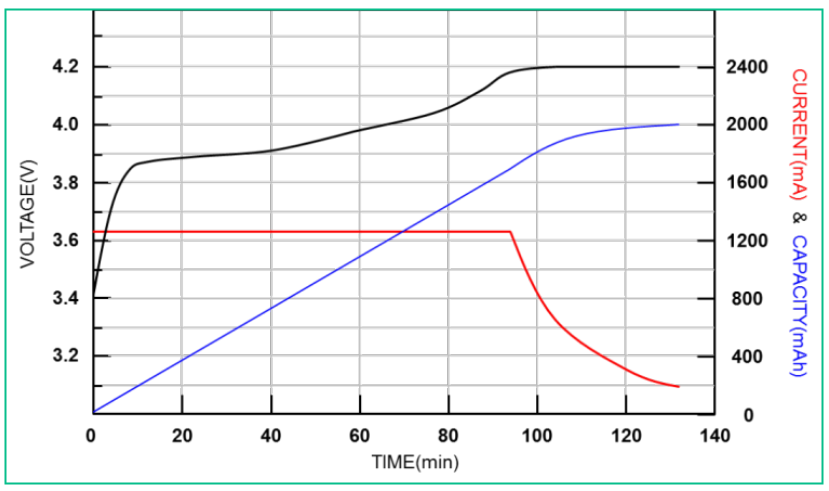
Figure 1 Charging curve of the CC+CV charging method
The two-stage charging method above is simple but has two drawbacks. First, after the battery is full the charger keeps applying N*4.2V to the battery; if this lasts too long there is a certain overcharge safety risk. Second, when the battery is deeply discharged, immediately applying high-current constant charging causes some internal damage (just like suddenly feeding rich food to a very weak person, which easily causes indigestion). Therefore, professional lithium battery chargers now all use a 4-stage charging strategy:
The first stage is pre-charging with a small constant current (0.05~0.1C recommended); after the battery voltage recovers to N*3.2V (lithium-ion) or N*3.0V (lithium iron phosphate), the second stage begins.
The second stage is the main charging stage with a large constant current (0.2C~1C recommended); once the battery voltage reaches N*4.2 or N*3.6V, the third stage of constant-voltage charging begins.
The third stage is constant-voltage charging, with the charging voltage held at N*4.2V or N*3.6V. The current in this stage gradually decreases as the battery fills; when the current falls below the set full-charge threshold — generally recommended as less than 0.05~0.02C — the battery is fully charged and the charger enters the fourth stage, shutting off output and monitoring battery self-discharge.
Shut-off + monitoring stage: the charging current is zero, and the charging circuit monitors the battery voltage in real time. If the battery voltage falls below N*4.0V or N*3.4V, the charger restarts a new charging cycle.
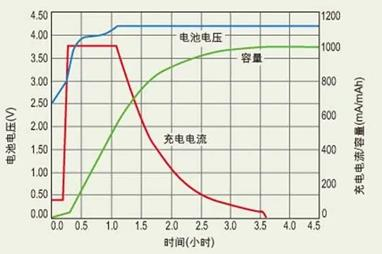
Figure 2 Four-stage charging curve
Lead-Acid Battery Charging Knowledge
For lead-acid batteries (the market today is dominated by sealed maintenance-free AGM and gel GEL types), the charging schemes generally include the following:
Ordinary two-stage: first a constant-current stage charges the battery with a steady current (usually 0.1C~0.2C); once the battery voltage gradually rises to N*2.28V (N is the number of cells in series; a single lead-acid cell is 2V, and the most common 12V battery is six cells in series, N=6), the charger switches to constant-voltage output at N*2.28V and maintains that voltage indefinitely — even when the battery is already full, the charger keeps this output voltage unchanged. This long-term applied voltage is also called the floating voltage. This method is the simplest, but the drawback is that a full charge takes too long, generally over 20 hours. It is mainly used in backup emergency power systems and UPS systems, where the battery normally does not discharge externally and only discharges when the mains power suddenly fails.
Standard three-stage: this is the most common lead-acid charging method for portable and mobile applications. First is the constant-current charging stage (bulk charge): fast charging at 0.2 times the battery capacity (e.g. 4A for a 48V 20Ah battery); when the voltage gradually rises to N*2.45V, it enters the constant-voltage stage (absorption): the voltage is held at N*2.45V (for a 12V battery with N=6, that is 14.7V), and the charging current naturally decreases for about 2-3 hours; when the charging current naturally decays to 0.02C (C is the battery capacity, 0.4A for 20Ah), it enters the trickle float stage (maintenance), where the charger voltage is lowered to N*2.28V and the charging current becomes very small (usually <0.1A for a 20Ah battery) — equivalent to the second stage of the two-stage method, and this maintenance voltage can be held for a long time. Its charging curve is shown in Figure 3:
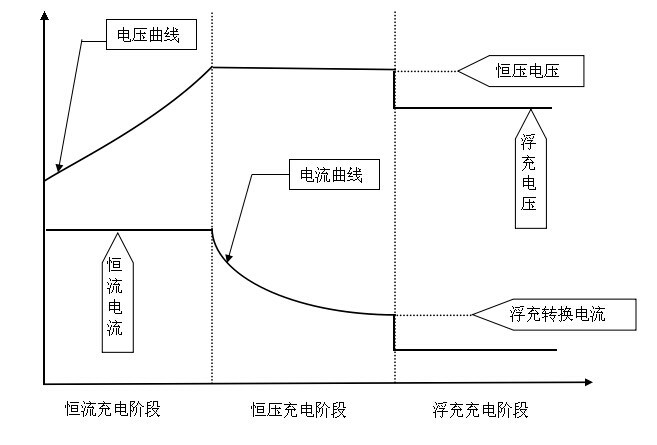
Figure 3 Lead-acid battery three-stage charging curve
Note that the charging voltages above are based on a room temperature of 25°C; when winter or summer temperatures deviate significantly, a temperature compensation coefficient of -4mV/°C must be considered. For example, at 0°C the battery maintenance voltage should be adjusted from N*2.28V to N*2.38V.
- Four-stage with pre-charge: it adds a pre-charge stage before the standard three stages. Theoretically this is friendlier to the battery, but the pre-charge stage is not really necessary because the bulk constant current is generally not large.
- Some chargers add repair charging or pulse functions; these concepts are mainly marketing gimmicks. Years of practical verification have shown unsatisfactory results, and they are rarely used now.
A Brief on NiMH Battery Charging
NiMH and NiCd batteries are charged in basically the same way: a two-stage scheme of 'constant-current bulk charge + small constant-current trickle'. In fact, by the end of the first stage — the high-current bulk charge (0.2~2C) — the battery is already 100% full. The small trickle current applied afterwards (0.01~0.02C) serves to counter NiMH self-discharge; since NiMH self-discharge is relatively large, applying a small trickle to a fully charged NiMH battery is quite necessary.
Note that deciding when to end the high-current bulk charge is difficult. It cannot be determined by a fixed voltage threshold as with lead-acid or lithium batteries (e.g. lithium-ion uses whether the voltage reaches N*4.2V to end the constant-current stage and enter constant voltage), nor by the charging current decaying to a given value. In fact, during charging, when a NiMH battery is almost full its charging current stays constant, and the highest voltage it reaches is not a fixed value — moreover, this value drops slightly as the battery fills. This phenomenon is called -dV (negative voltage change). -dV is unique to NiMH and NiCd charging; lead-acid and lithium batteries do not exhibit it. A good NiMH charger must accurately capture the occurrence of -dV and use it as the full-charge signal to end the bulk charge and switch to trickle mode. In addition, when a NiMH battery is almost full its temperature rises rapidly; this characteristic can also be used to determine full charge very accurately.
Figure 4 shows the charging curve of a NiMH charger: black is voltage, red is current, and the section of the voltage curve inside the green circle is the -dV phenomenon (the voltage drops slightly after reaching its peak)
Since the -dV of a NiMH battery is very small — typically only 3~6mV per cell — high demands are placed on the charger's detection capability, which must be supported by high-precision, low-noise digital detection circuitry.
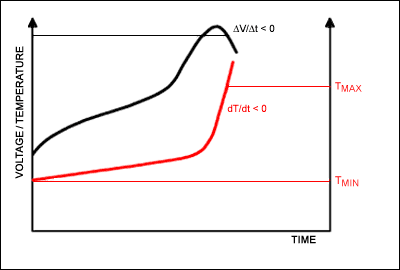
Figure 4 NiMH and NiCd battery charging curves